Steven Gough-Kelly

Steven Gough-Kelly

PhD Student | Galactic Dynamics

Jeremiah Horrocks Institute, UCLan

Welcome...

I am a PhD research student at the Jeremiah Horrocks Institute, University of Central Lancashire as part of the Galaxy Dynamics research group led by Prof. Victor P. Debattista. My primary research is studying the formation and evolution of box/peanut bulges in barred galaxies by comparing isolated and cosmological simulations to observations of external galaxies and the Milky Way.

My position is funded by the Moses Holden Studentship, dedicated to the Lancashire astronomer and educator. I am currently a Junior Associate of the LSST:UK Consortium as part of the Galaxies; Stars, Milky Way and Local Volume Science Collaboration and a member of the N-Body Shop. Part of my current research, Gough-Kelly et al. (2022), bridges these two memberships by making predictions for kinematic differences between populations within the Milky Way bulge.

I am also currently Vice Chair of the Royal Astronomical Society Early Career Network Steering Committee. Find out more about the network here.

Education

PhD in Galaxy Dynamics

2019-01-01

Jeremiah Horrocks Institute, UCLan

MSc by Research in Astrophysics

2018-01-01
2019-12-31

Jeremiah Horrocks Institute, UCLan

BSc (Hons) Astrophysics

2015-01-01
2018-12-31

University of Central Lancashire

Interests

Galactic Structure Galactic Formation and Evolution Galactic Dynamics Computational Astrophysics
Research

Galaxy dynamics helps us understand how galaxies form and evolve over time. My research focuses on the evolution of the central structures of disc galaxies, such as bars, nuclear discs, and bulges in galaxies similar to the Milky Way.

We are particularly interested in the slow internal processes that dominate large-scale changes over the billions of years following the initial turbulent formation period.

Read more about my research.

Publications
The edge of the Milky Way's star-forming disc: Evidence from a 'U-shaped' stellar age profile featured image

The edge of the Milky Way's star-forming disc: Evidence from a 'U-shaped' stellar age profile

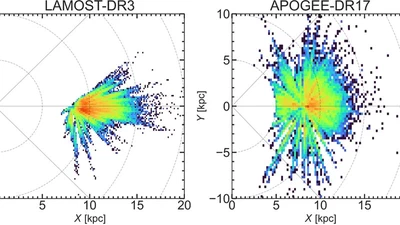
We leveraged reliable age and distance estimates from LAMOST-DR3 and APOGEE-DR17+AstroNN combined with Gaia data to perform a detailed analysis of the stellar age distribution in …

fiteni-karl
The chemical and spatial variations of the bulge's velocity ellipsoids featured image

The chemical and spatial variations of the bulge's velocity ellipsoids

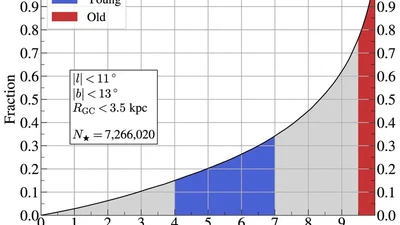
We study the velocity ellipsoids in an N-body$+$SPH (smooth particle hydrodynamics) simulation of a barred galaxy which forms a bar with a BP bulge. We focus on the 2D kinematics, …

san-martin-fernandez-luis-m.
The Galactic bulge exploration: V. The secular spherical and X-shaped Milky Way bulge featured image

The Galactic bulge exploration: V. The secular spherical and X-shaped Milky Way bulge

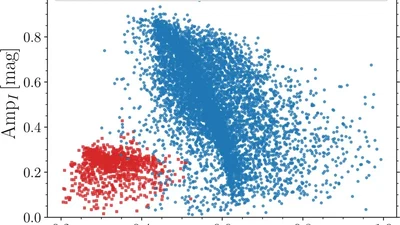
In this work, we derive systemic velocities for 8456 RR Lyrae stars. This is the largest dataset of these variables in the Galactic bulge to date. In combination with Gaia proper …

prudil-z.
The Galactic bulge exploration: IV. RR Lyrae stars as tracers of the Galactic bar: 3D and 5D analysis and extinction variation featured image

The Galactic bulge exploration: IV. RR Lyrae stars as tracers of the Galactic bar: 3D and 5D analysis and extinction variation

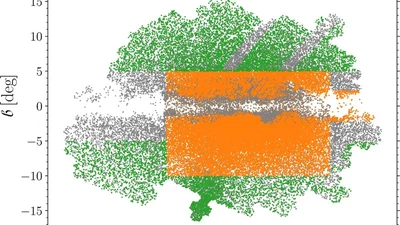
RR Lyrae stars toward the Galactic bulge are used to investigate whether this old stellar population traces the Galactic bar. Although the bar is known to dominate the mass in the …

prudil-z.

VizieR Online Data Catalog: Galactic bar/bulge traced by RRLs (Prudil+, 2025)

In this study, we have analyzed the spatial and transverse velocity distribution of RR Lyrae stars toward the Galactic bulge. We utilized data from OGLE-IV, Gaia, VVV, and VHS …

prudil-z.
Recent Publications
(2026). The edge of the Milky Way's star-forming disc: Evidence from a 'U-shaped' stellar age profile. Astronomy and Astrophysics.
(2025). The chemical and spatial variations of the bulge's velocity ellipsoids. Monthly Notices of the Royal Astronomical Society.
(2025). The Galactic bulge exploration: V. The secular spherical and X-shaped Milky Way bulge. Astronomy and Astrophysics.
(2025). The Galactic bulge exploration: IV. RR Lyrae stars as tracers of the Galactic bar: 3D and 5D analysis and extinction variation. Astronomy and Astrophysics.
(2025). VizieR Online Data Catalog: Galactic bar/bulge traced by RRLs (Prudil+, 2025). VizieR Online Data Catalog.
Contact