The interplay between accretion, downsizing, and the formation of box/peanut bulges in TNG50
Jan 1, 2024· ,·
0 min read
,·
0 min read
Steven Gough-Kelly
et al.
Abstract
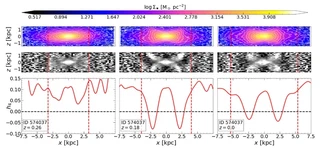
From the TNG50 cosmological simulation we build a sample of 191 well-resolved barred galaxies with stellar mass log(M⋆/M⊙)>10 at z = 0. We search for box/peanut bulges (BPs) in this sample, finding them in 55 per cent of cases. We compute fBP, the BP probability for barred galaxies as a function of M⋆, and find that this rises to a plateau, as found in observations of nearby galaxies. The transition mass where fBP reaches half the plateau value is log(M⋆/M⊙)=10.13±0.07, consistent with the observational value within measurement errors. We show that this transition in fBP can be attributed to the youth of the bars at low M⋆, which is a consequence of downsizing. Young bars, being generally shorter and weaker, have not yet had time to form BPs. At high mass, while we find a plateau, the value is at ∼60 per cent whereas observations saturate at 100 per cent. We attribute this difference to excessive heating in TNG50 due to merger activity and numerical resolution effects. BPs in TNG50 tend to occur in galaxies with more quiescent merger histories. As a result, the main driver of whether a bar hosts a BP in TNG50 is not the galaxy mass, but how long and strong the bar is. Separating the BP sample into those that have visibly buckled and those that have not, we find that fully half of BP galaxies show clear signs of buckling, despite the excessive heating and limited vertical resolution of TNG50.
Type
Publication
Monthly Notices of the Royal Astronomical Society

Authors
PhD Student | Galactic Dynamics
Steven Gough-Kelly is a PhD research student at the Jeremiah Horrocks
Institute, University of Central Lancashire. His research focuses on the
formation and evolution of box/peanut bulges in barred galaxies, comparing
isolated and cosmological simulations with observations of external galaxies
and the Milky Way.