The chemical and spatial variations of the bulge's velocity ellipsoids
Jul 1, 2025·
,,,,,·
0 min read
San Martin Fernandez, Luis M.
Steven Gough-Kelly
Debattista, Victor P.
Gonzalez, Oscar A.
Lazar, Ilin
Rojas-Arriagada, Alvaro
Beraldo e Silva, Leandro
Abstract
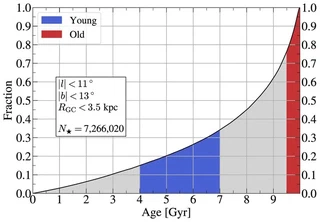
We study the velocity ellipsoids in an N-body$+$ SPH (smooth particle hydrodynamics) simulation of a barred galaxy which forms a bar with a BP bulge. We focus on the 2D kinematics, and quantify the velocity ellipses by the anisotropy, $\beta _{ij}$ , the correlation, $\rho _{ij}$ , and the vertex deviation, $l_{\rm v}$ . We explore the variations in these quantities based on stellar age within the bulge and compare these results with the Milky Way’s bulge using data from APOGEE (Apache Point Observatory Galactic Evolution Experiment) DR16 and Gaia DR3. We first explore the variation of the model’s velocity ellipses in galactocentric velocities, $v_R$ and $v_\phi$ , for two bulge populations, a (relatively) young one and an old one. The bar imprints quadrupoles on the distribution of ellipse properties, which are stronger in the young population, as expected from their stronger bar. The quadrupoles are distorted if we use heliocentric velocities $v_r$ and $v_l$ . We then project these kinematics along the line of sight onto the $(l,b)$ -plane. Along the minor axis $\beta _{rl}$ changes from positive at low $|b|$ to negative at large $|b|$ , crossing over at lower $|b|$ in the young stars. Consequently, the vertex deviation peaks at lower $|b|$ in the young population, but reaches similar peak values in the old. The $\rho _{rl}$ is much stronger in the young stars, and traces the bar strength. The APOGEE stars split by the median $\rm [Fe/H]$ follow the same trends. Lastly, we explore the velocity ellipses across the entire bulge region in $(l,b)$ space, finding good qualitative agreement between the model and observations.
Type
Publication
Monthly Notices of the Royal Astronomical Society

Authors
PhD Student | Galactic Dynamics
Steven Gough-Kelly is a PhD research student at the Jeremiah Horrocks
Institute, University of Central Lancashire. His research focuses on the
formation and evolution of box/peanut bulges in barred galaxies, comparing
isolated and cosmological simulations with observations of external galaxies
and the Milky Way.