The edge of the Milky Way's star-forming disc: Evidence from a 'U-shaped' stellar age profile
Apr 1, 2026·,,,, ,,,,·
0 min read
,,,,·
0 min read
Fiteni, Karl
Anderson, Stuart Robert
Debattista, Victor. P.
Caruana, Joseph
Amarante, João A. S.
Steven Gough-Kelly
Eyer, Laurent
Beraldo e Silva, Leandro
Khachaturyants, Tigran
Cuomo, Virginia
Abstract
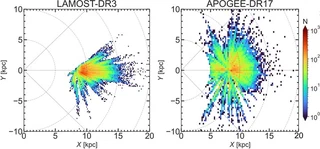
We leveraged reliable age and distance estimates from LAMOST-DR3 and APOGEE-DR17+AstroNN combined with Gaia data to perform a detailed analysis of the stellar age distribution in the Milky Way’s (MW) outer disc using giant stars. Selecting stars near the midplane (|z| < 0.3 kpc) on near-circular orbits (λc > 0.9), we analysed these independent datasets that employed different age-estimation methods. Our stringent kinematic selection criteria effectively exclude halo stars, ensuring that the observed age trends reflect genuine disc properties rather than contamination from older halo populations. Our results reveal a ‘U-shaped’ stellar age profile, where a negative gradient in the inner disc transitions to a positive gradient in the outer disc region. We identify the minimum in the stellar age profile at Rmin = 11.28 ± 0.58 kpc and Rmin = 12.15 ± 0.62 kpc for the APOGEE-DR 17 and LAMOST-DR3 samples, respectively. Using N-body+SPH simulations, we demonstrate that Rmin corresponds to the break radius in the stellar density profile (Rbr), marking the edge of the Galaxy’s star-forming disc. This break arises from a sharp decline in the star formation rate, with the outer positive age gradient produced by the radial migration of stars born inside Rbr. The cessation of star formation in the outer disc might be due to several mechanisms, including the dynamical influence of the bar’s outer Lindblad resonance, the onset of the Galactic warp, or thermally regulated star formation. Overall, our results support the picture that the MW has a Type II (down-bending) stellar disc with a break at Rbr ≍ 11.28─12.15 kpc, where the combination of star-formation cut-off and radial migration produces the observed U-shaped age profile.
Type
Publication
Astronomy and Astrophysics

Authors
Astrophysics Researcher | Galactic Dynamics
Steven Gough-Kelly is an astrophysics researcher at the Jeremiah Horrocks
Institute, University of Lancashire. His research focuses on the
formation and evolution of box/peanut bulges in barred galaxies, comparing
isolated and cosmological simulations with observations of external galaxies
and the Milky Way.